

 macOS
 Windows
 Linux
 Android
 Chrome extension
 Slack app


Tools the desk already uses.
The ticket system, the inbox and the notes already on the customer.


The next ticket, already walked.
An escalation day by day, a handover for the next agent, an invoice next to the payment. Each answer cites what it used.
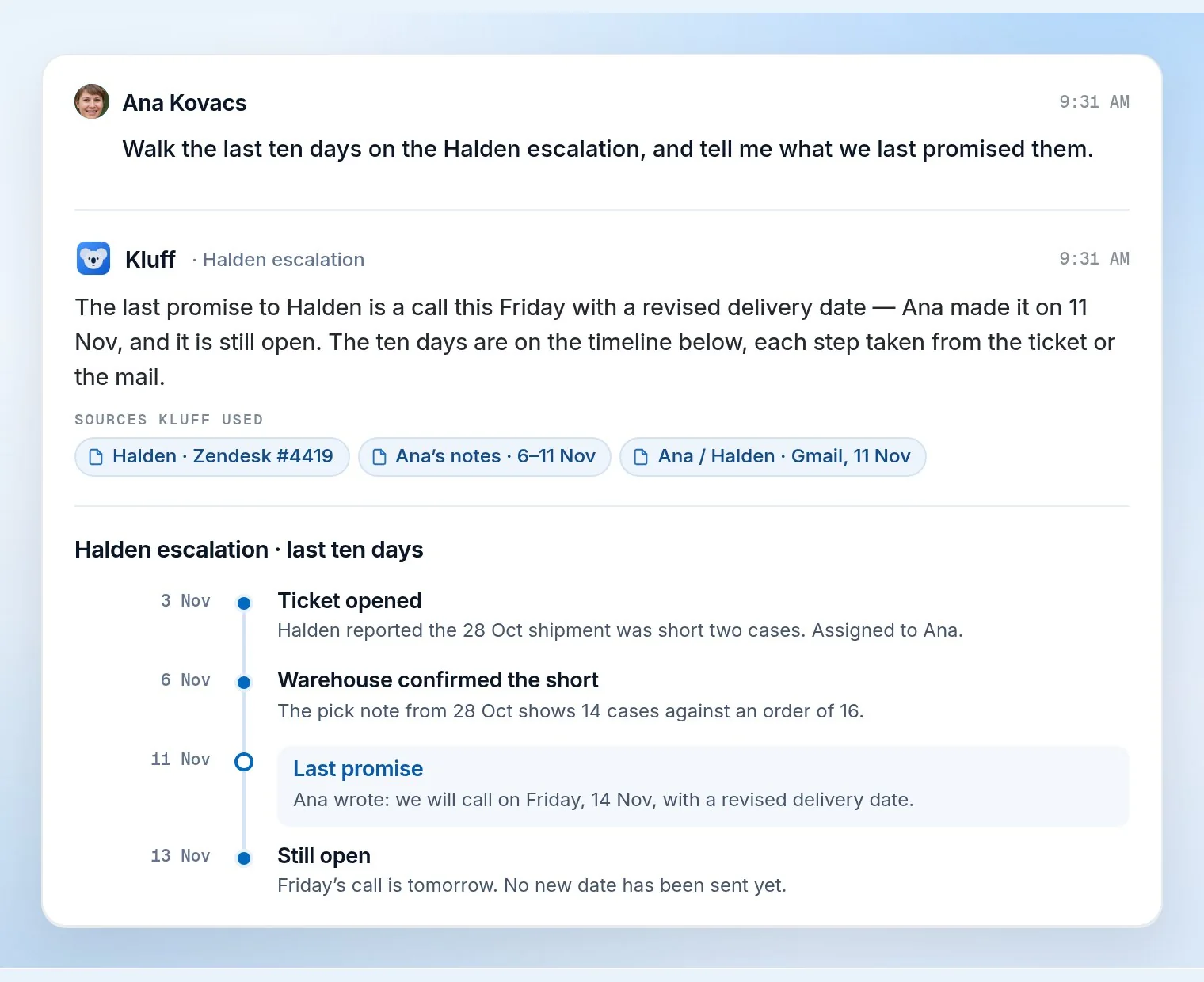
Walk the last ten days on the Halden escalation, and tell me what we last promised them.
The last promise is a call on Friday with a revised delivery date, made by Ana on 11 Nov. The ten days sit on a timeline, each step with the note it came from.
Answered from the Halden Zendesk ticket, Ana’s notes, and the last outbound mail.
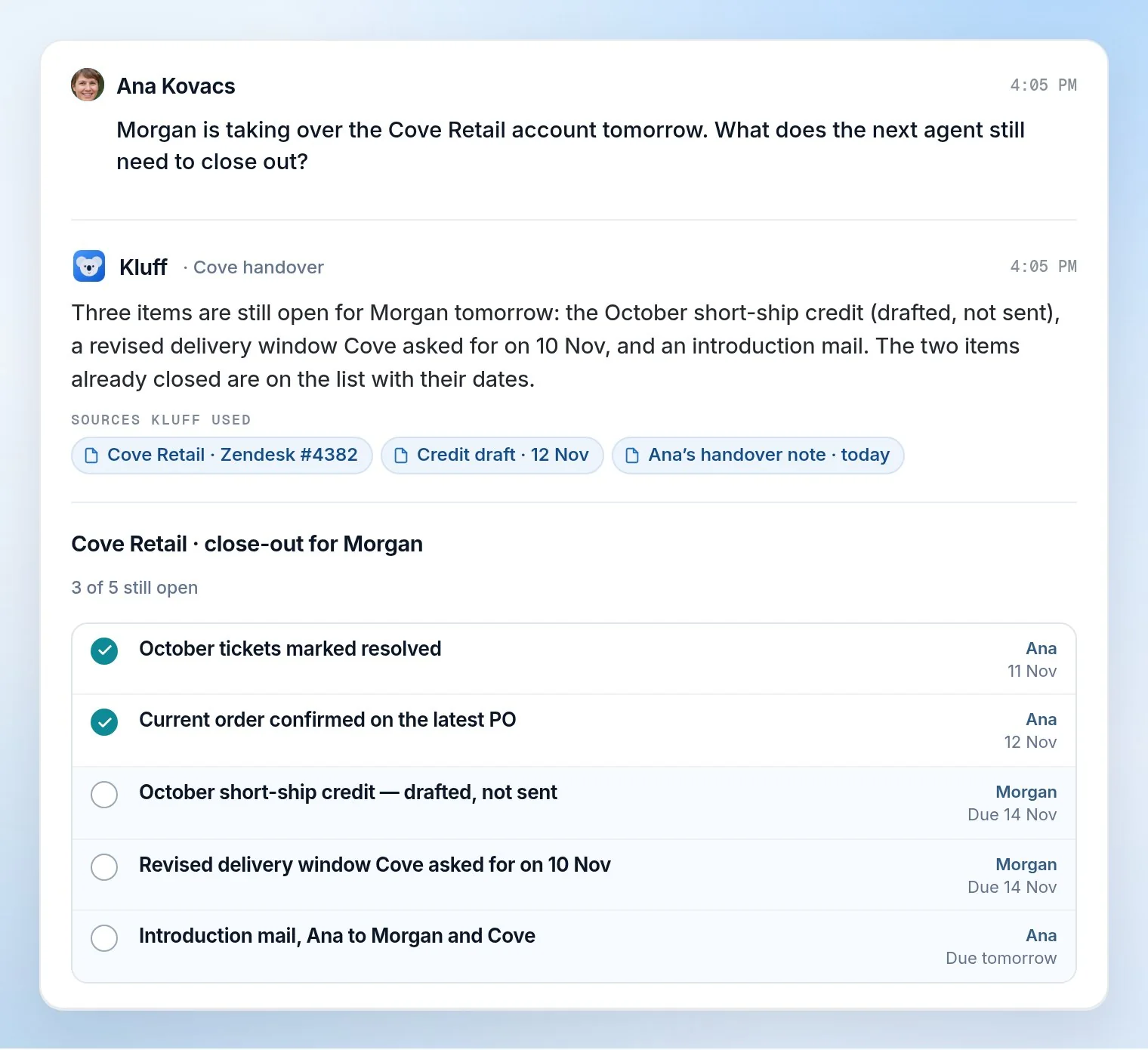
Morgan is taking over the Cove Retail account tomorrow. What does the next agent still need to close out?
Three items are still open: a credit for the October short, a revised delivery window, and an introduction to Morgan. What’s already done sits next to what’s left.
Answered from the Cove Retail ticket, the open credit, and Ana’s handover note.
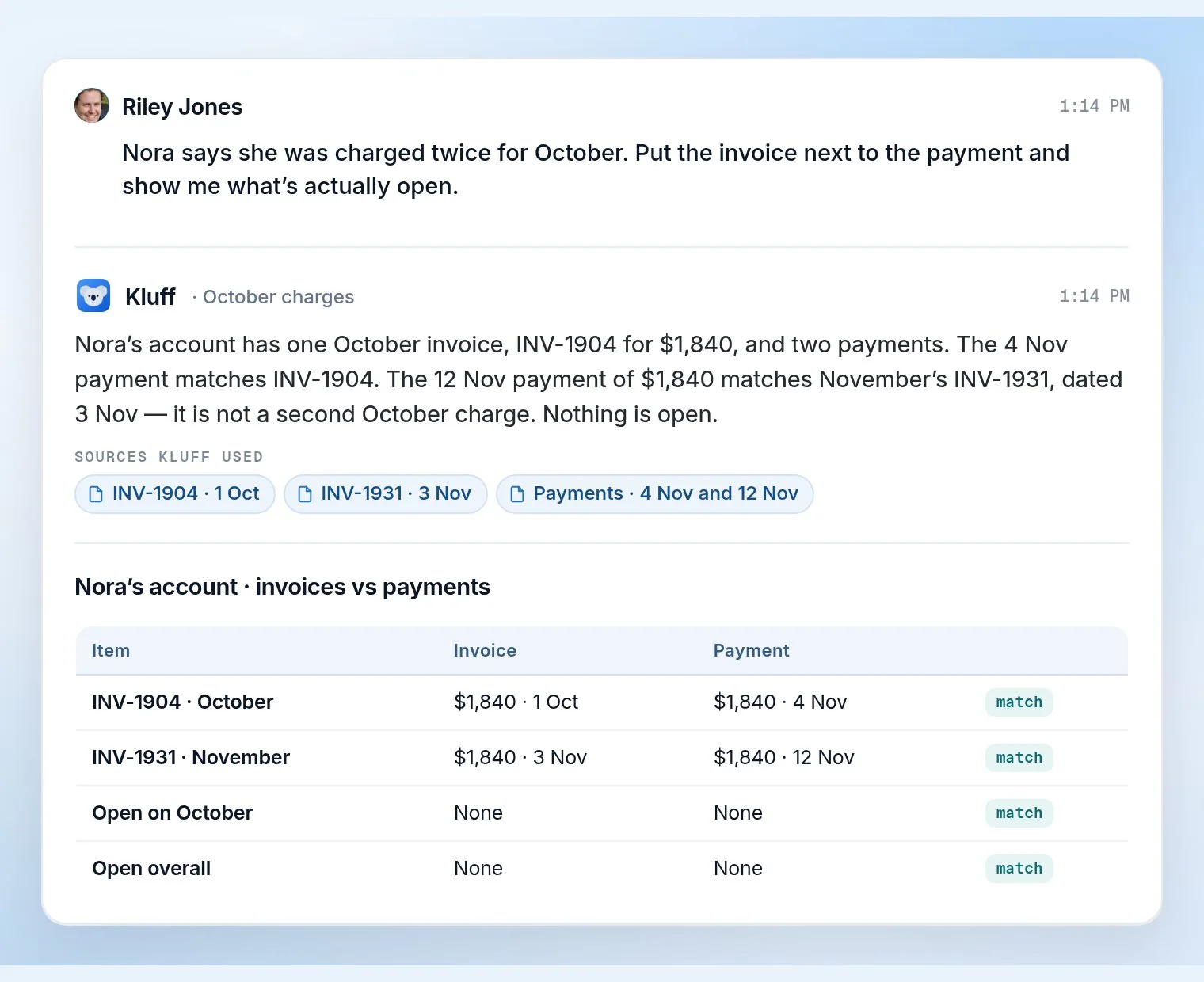
Nora says she was charged twice for October. Put the invoice next to the payment and show me what’s actually open.
There is one October invoice and two payments. The second payment matches a November invoice dated 3 Nov, already on file — nothing is actually open.
Answered from October invoice INV-1904, the two payments, and November invoice INV-1931.
What Kluff knows about your customer experience team
Customers, open tickets, orders and the tools the desk already uses — one shared record the next agent can pick up.

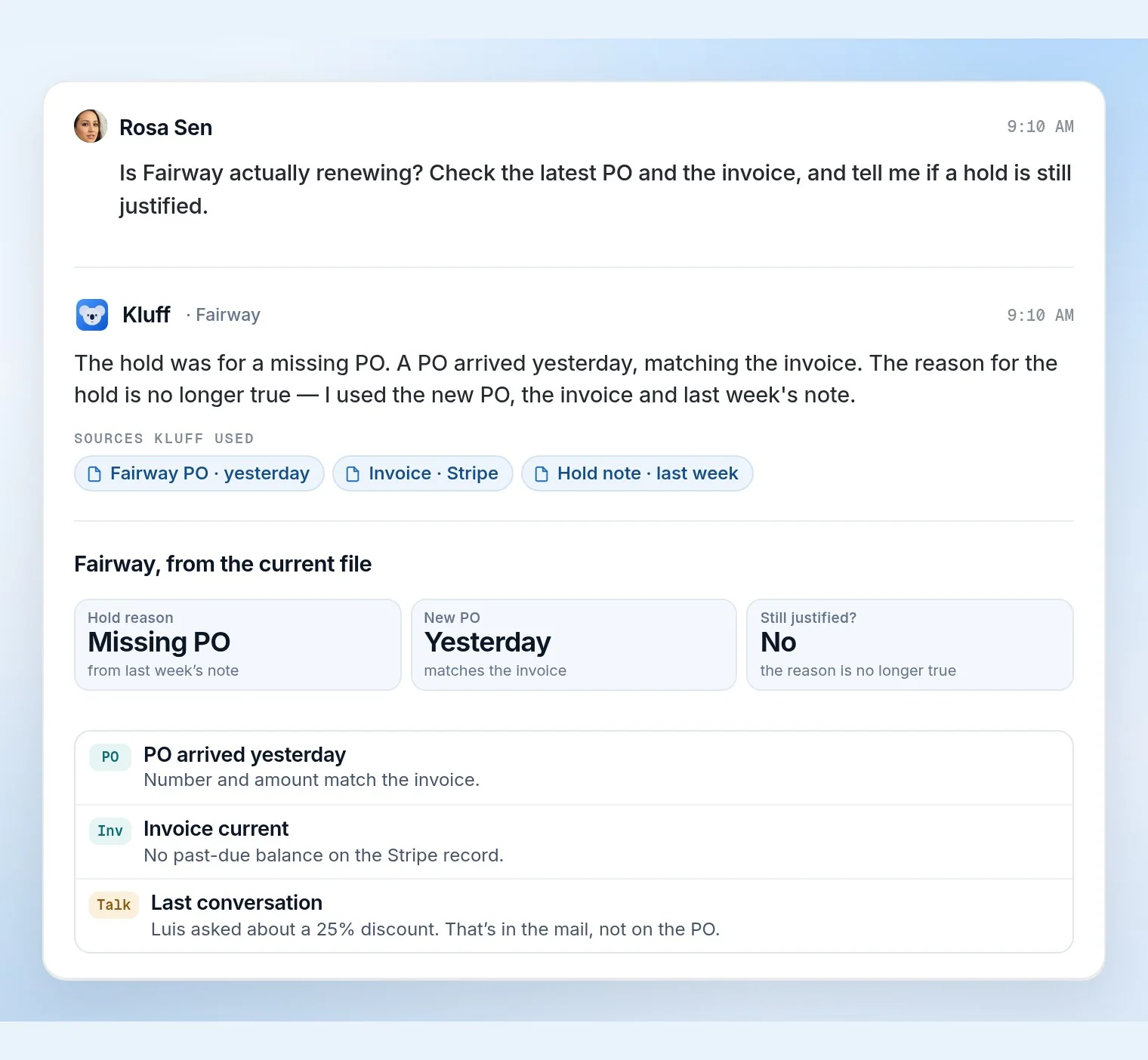
Is Fairway actually renewing? Check the latest PO and the invoice, and tell me if a hold is still justified.
AI agents for customer service
Customer service AI agents use support information and tools to answer questions or complete service tasks. Kluff agents help teams assemble customer context, prepare responses and investigate account issues from connected records. Available actions depend on the integrations and access configured for the agent.
A scripted chatbot follows predefined conversation paths. An AI agent can interpret a request, retrieve context and use tools to carry out a task. Kluff agents work with project conversations and connected sources so a support team can investigate an issue alongside preparing a reply.
Agents can gather account history, summarize conversations, draft replies and check order or billing records. Kluff can help a customer experience team prepare a case handover, review a renewal question or compare the latest customer information with earlier notes.
Kluff agents can use accessible knowledge documents and project context when preparing an answer. Providing current policies, product guidance and approved examples helps the agent use the team’s information. Review answers where guidance is missing, conflicting or dependent on a customer-specific exception.
Kluff agents can use available order records and supplier updates to summarize a current status or backorder date. They can identify an approved substitute when that information is present. A support team should verify freshness and availability before making a delivery promise to a customer.
Kluff agents can compare available purchase orders, invoices and account notes to summarize a renewal or highlight changes that may indicate risk. These are signals for an account owner to investigate, rather than a guaranteed prediction of whether a customer will renew.
Yes. Kluff agents can draft a response using the customer’s available account context, recent conversation and relevant policy. The team can review the facts, tone and commitments before sending. This is useful when the answer spans an order, invoice and several prior messages.
Agents can prepare a handoff summary that explains the issue, work already attempted and information still needed. In Kluff, that summary can draw on the project conversation and connected records. The receiving teammate gets context to review before deciding the next action.
Kluff agents can compare a sample of support conversations against a rubric supplied by the team and organize examples for review. Managers should validate the assessments and use the supporting conversations when deciding whether a response needs improvement or a teammate needs coaching.
Start with an internal task such as case summaries or reply drafts. In Kluff, supply approved guidance, connect the relevant records and have support staff review the outputs. Expand the scope after checking answer quality, missing context and how exceptions reach the right person.